







Documents Legalisation in London: Get It Right
February 20, 2026
MOFA Legalisation for Saudi Documents Explained
February 22, 2026
You usually find out you need legalisation at the worst possible moment – after your employer has set a start date, after HR has booked a medical, or when the Saudi platform rejects an upload because the stamp chain is wrong.
If you are applying from the UK, the phrase you will hear most is “apostille”. For Saudi Arabia, that is often only one part of the compliance chain. What matters is whether your document must be accepted in the Kingdom for a visa, a residency file, or a regulated job function, and which authority will check it.
Apostille for Saudi Arabia UK: what it actually means
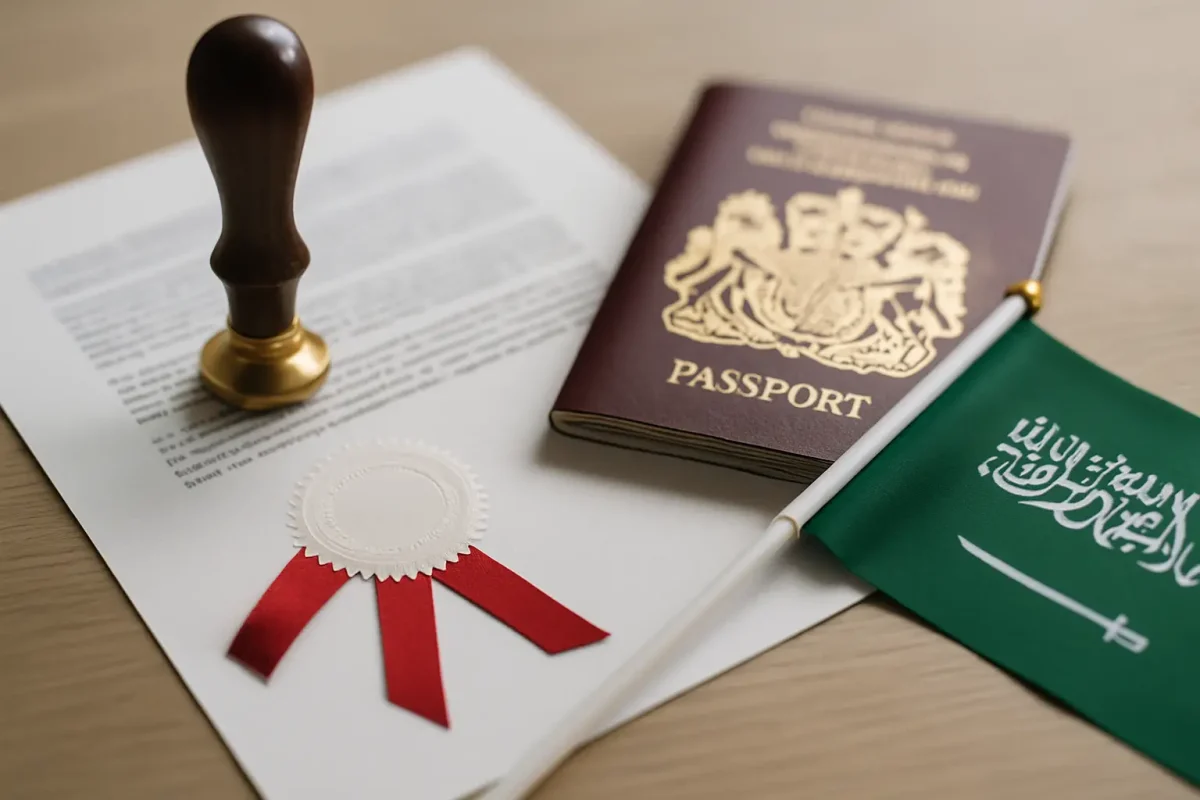
An apostille is a UK-issued certificate that confirms the authenticity of a UK public document or the signature/seal on it. In practice, it is used to make a UK document acceptable for use abroad.
The key nuance for Saudi Arabia is this: an apostille can be necessary but not always sufficient. Saudi processes frequently require further legalisation steps after the apostille, depending on the document type and the route your application takes (work visa, family, business, or post-arrival processing).
If you are trying to keep timelines predictable, treat “apostille” as the trigger to check the full chain. Many delays come from assuming the apostille is the final stamp when the receiving party expects additional authentication.
When you typically need legalised documents for Saudi Arabia
Most requests for apostille and legalisation come from three situations.
First, Saudi work and temporary work routes often need legalised education and professional documents, especially where the role is regulated or the employer must evidence qualifications.
Second, family residence and visit routes can require legalised civil status documents, such as marriage or birth certificates, to match sponsor details and support dependent eligibility.
Third, corporate and business activity can trigger legalisation of company documents, authorisations, or letters when a Saudi counterparty requires proof that a UK-issued document is genuine.
It depends on your sponsor, your job title, and the platform checks applied to your case. If your employer or agent cannot tell you exactly which authority will verify the document in Saudi Arabia, assume you need to validate the chain before you submit anything.
Which UK documents can be apostilled
Apostilles are commonly applied to UK-issued documents that are either public documents or have been correctly certified for apostille purposes.
That usually includes:
- UK birth, marriage and death certificates
- ACRO police certificates (where required by your route or employer)
- Degree certificates and transcripts
- Professional membership letters or certificates
- Company documents and signed declarations
The main compliance risk is not the document itself but the format. For example, a degree certificate might be acceptable, but only if it is the correct version, correctly certified, and consistent with your passport name. A marriage certificate might be fine, but the receiving authority may reject it if it is damaged, incomplete, or does not match the sponsor’s details.
Before you apostille anything, check names, dates, and spelling across your passport, offer letter, and any supporting documents. Fixing discrepancies after legalisation is where people lose weeks.
Apostille vs MOFA legalisation for Saudi Arabia
People often use “apostille” and “legalisation” interchangeably. For Saudi Arabia workflows, separating them helps you avoid incorrect assumptions.
An apostille is a UK authentication step.
MOFA legalisation refers to the Saudi Ministry of Foreign Affairs authentication step that may be required for certain documents to be recognised within Saudi systems or for downstream processes. Whether you need MOFA involvement depends on what the document will be used for in Saudi Arabia.
This is where “it depends” becomes operational:
- If the document is only being reviewed by a UK-side reviewer, an apostille might be all they ask for.
- If the document will be relied on in Saudi Arabia for residency, employment file completion, or official registration, you may be asked for additional legalisation beyond the apostille.
Do not wait for a rejection to learn this. If a sponsor or HR team says “we need it legalised for Saudi”, ask them to specify: apostille only, or apostille plus Saudi-side steps.
Common document chains (and where mistakes happen)
There is no single chain that fits every applicant, but most problems come from one of these points.
Incorrect certification before apostille
Some documents require certification in a specific way before they can be apostilled. If the certification wording, signature, or professional status of the certifier is not acceptable, your apostille application can fail or the document can be questioned later.
Mixing originals and copies without a plan
Certain documents are best processed as originals; others are commonly legalised as certified copies. Mixing approaches mid-process can create inconsistencies in stamps and page sets. Saudi reviewers tend to be strict on completeness – missing pages, missing seals, or an apostille attached to the wrong document set can trigger rework.
Name alignment issues
If your passport shows a middle name that your degree omits, or your marriage certificate reflects a different surname format, you can hit a compliance gap. Some sponsors accept a supporting declaration; others will insist on a corrected document or an additional legalised linking document.
Translation expectations
Saudi-facing processes may require Arabic translation for certain documents. The translation may also need to be tied to the legalised document set. Leaving translation to the end is a common cause of missed start dates.
Timelines: what slows apostille and legalisation down
If your start date is fixed, the real question is not “how long does an apostille take?” but “how many handoffs are in my chain, and where can the chain break?”
Delays typically come from:
- Waiting for replacement originals (civil certificates, reissued letters)
- University verification steps or slow registrar responses
- Rejected certification wording or incorrect signing
- Last-minute discovery that additional Saudi-side legalisation is needed
If you are working with an employer, ask them to confirm whether your role triggers extra verification steps such as QVP or profession-specific checks, because those requirements can change what documents must be legalised and how.
A practical way to avoid rework
If you are managing this as an individual applicant, or you are HR trying to standardise processing for multiple hires, use a controlled sequence.
Start by confirming the visa type and the sponsor’s checklist, then freeze the document set. That means you do not keep swapping versions as you go.
Next, do a name and data audit across every item. This sounds basic, but it prevents the most expensive kind of delay: a fully apostilled and legalised document that no longer matches the final visa application.
Then decide which items will be processed as originals and which as certified copies, and keep each document bundle intact. Finally, schedule translation (if needed) as part of the chain, not as an afterthought.
If you want a single operator to manage apostille and Saudi-side compliance steps alongside the visa workflow, SaudiVisa.London provides end-to-end document processing and visa submission handling for applicants in London and internationally.
FAQs that actually come up in HR and relocation cases
Do I need an apostille for Saudi Arabia if I am only going for a short business trip?
Often not, but it depends on what you are doing and what your host organisation demands. Standard business travel can be light on legalised documents, but if the Saudi counterparty requires proof of role, authorisation, or corporate status, you can still be asked for legalised paperwork.
Can I apostille a scan?
Apostilles are applied to an original document or to a properly certified copy, depending on the document and the certification. A plain scan printed at home is rarely acceptable as a base document.
What if my document is not UK-issued?
If your qualification or civil document was issued outside the UK, a UK apostille will not usually be the correct route. You normally need legalisation from the issuing country first, then align it to the Saudi requirements. This is common for global hires living in London with overseas degrees.
Should I apostille my ACRO police certificate?
Sometimes, yes. Whether you need it apostilled and whether further legalisation applies depends on your visa route and sponsor policy. Treat it as a controlled document with expiry sensitivity – do not order it too early if your employer will only accept a recent issue.
Legalisation is not difficult when the chain is clear. The hard part is doing it once, correctly, with no rework. If you plan your document set like a compliance file rather than a quick errand, you protect the one thing every Saudi mobilisation depends on: your timeline.


