







ACRO Police Certificate times in the UK
February 27, 2026
QVP Verification: What HR Teams Get Wrong
March 2, 2026
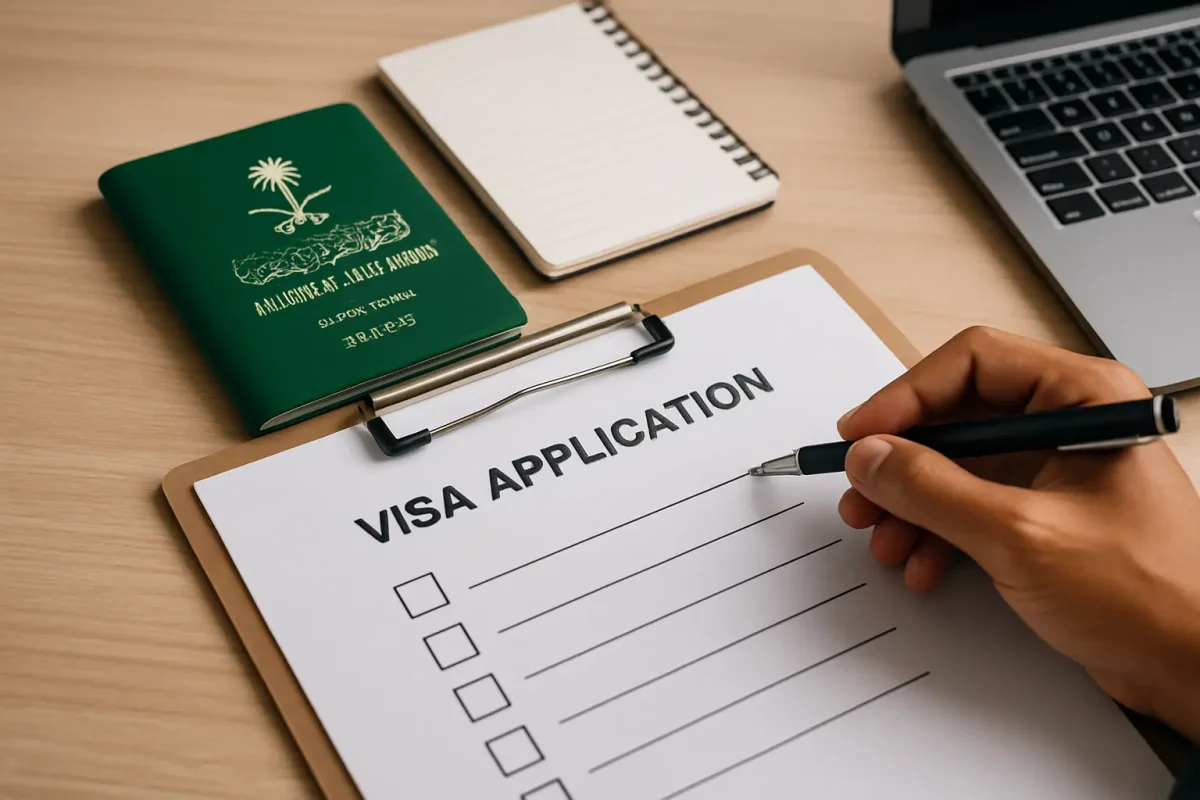
If your sponsor says, “We need you in Riyadh in three weeks,” your calendar is not the problem. The document chain is. Saudi work visas are approved on compliance, not intent – and most delays come from small, avoidable document gaps (a mismatched job title, an un-legalised degree, a medical report from the wrong clinic, or a police certificate outside validity).
This guide is written for HR teams, mobility managers, recruiters, and professionals applying from London or internationally. It explains what a Saudi work visa document checklist really looks like in practice, where applications get slowed down, and what “ready for submission” means when QVP and Mosadaqa checks are in scope.
The Saudi work visa document checklist – what it covers
A Saudi work visa is not a single form. It is a sequence that ties your personal identity documents to your employment documents, then aligns both with Saudi-side approvals. The checklist therefore spans four areas: personal documents, employment and sponsor documents, qualification and verification items, and medical and clearance requirements.
It also depends on two variables: your nationality and your job category. Regulated professions (engineering, healthcare, certain technical roles) typically face tighter scrutiny on qualifications and professional standing. If your passport or residency situation is complex (dual nationality, recent renewal, name changes), you should expect extra cross-checks.
Identity documents – get these right first
Your passport is the anchor document. It must be valid for the required period and in good condition. Pages should be clean, and any details must match exactly across all supporting paperwork.
You will typically prepare passport scans (photo page, any relevant endorsements) and passport-style photographs that meet embassy specifications. If you have used different spellings of your name across documents (for example, initials on a degree but full name on your passport), fix it early. Saudi submissions do not respond well to “close enough” identity matching.
If you are applying from the UK but are not a British citizen, you may also need evidence of lawful UK residence (such as a BRP or eVisa status evidence) to support the London submission route. This is one of the most common “we can’t lodge it yet” issues for international staff based in the UK.
Sponsor and employment paperwork – alignment matters
Saudi work visas are sponsor-driven. That means your documents must align with the sponsor’s approvals and the role defined in Saudi systems.
At minimum, expect an employment contract or offer details and a sponsor-issued authorisation path that enables visa issuance. The key is not the volume of paperwork – it is consistency. Job title, job function, and sometimes even the degree field must match across the sponsor’s request, your qualification evidence, and any verification portals.
If your sponsor changes the role title late in the process (common when Saudisation quotas or internal HR grading changes), the ripple effect can be significant. A title change can trigger a need to re-verify qualifications or re-issue supporting letters. The best practice is to freeze the job title and occupation category before you start legalisation and verification.
Qualifications – the part that causes most delays
For many work visa categories, your highest relevant qualification is not just “nice to have”. It is used as proof that the role is legitimate and that you meet professional criteria.
You will usually need your degree certificate and, in some cases, transcripts. If the degree is not in English, you may need a certified translation. If your name differs due to marriage or deed poll, you should prepare the linking evidence as part of the chain so the embassy does not have to infer it.
Legalisation and MOFA-style steps
A frequent misunderstanding is assuming a university certificate can be submitted “as is”. In many cases it must be legalised through an apostille process and then processed in line with Saudi requirements, which can include further Saudi-side steps.
The trade-off is simple: legalisation adds time upfront, but it reduces rejection risk at the submission stage. If you skip it and the case is paused, you often lose more time than you saved.
QVP and Mosadaqa – verification is not optional in many cases
Depending on your nationality, profession, and the current regulatory posture, you may be asked for qualification verification through the QVP pathway, and in many scenarios Mosadaqa verification also comes into play.
These checks are designed to validate that your qualification is genuine and relevant. The practical impact is that document format, issuing institution details, and even scan quality matter. Poor scans, cropped stamps, or missing reverse pages can trigger rework.
If you are an employer moving multiple hires, standardise how documents are scanned and named. It sounds operational, but it is one of the highest leverage ways to reduce cycle time across a cohort.
Police clearance – plan for lead times
Many applicants will need a police clearance certificate, typically an ACRO Police Certificate for UK applicants. The key risk is timing. Police certificates have a validity window for visa purposes, and if you order too early you can end up holding a document that is technically valid but outside the acceptance range by the time you submit.
If the applicant has lived in multiple countries, additional police certificates may be required. This is an “it depends” scenario and should be assessed early, because overseas police clearances can take weeks or longer.
Medical requirements – use the right clinic and format
Saudi work visas commonly require a medical examination and a medical report in a specified format. This is not a general GP note. The report must cover the required tests and be issued by a clinic that produces reports acceptable for Saudi submission.
The main failure points are: incomplete test panels, missing doctor signatures or stamps, incorrect photo attachment, and inconsistent passport numbers. Treat the medical report as a controlled document. Check every field against the passport before it is finalised.
Photos, forms, and supporting declarations
Beyond the major documents, Saudi work visa submissions often include application forms and declarations that are sensitive to small errors.
Photos need to meet exact dimensions and background requirements. Forms need to match passport details precisely, including place of birth and issue dates. If your passport was recently renewed, update every form and letter – do not assume the system will reconcile old numbers.
How to assemble your file so it passes first time
The difference between a smooth submission and a stalled one is usually file discipline. Create a single “master pack” where each document is legible, complete, and consistent.
Start by confirming the sponsor’s role title and occupation category. Next, ensure identity documents match across every page. Then move to qualifications: verify you have the correct certificate version, all pages, and the required legalisation and verification steps lined up. Finally, schedule police clearance and medicals so they land inside the acceptable timing window.
If you are running this through HR, treat it like a compliance workflow rather than a document request. Assign an owner, set cut-off dates for each dependency, and keep a version-controlled record of what was submitted.
Common delay triggers you can prevent
Most refusals and long pauses are not mysterious. They are predictable.
The first is mismatch: job title differs between sponsor paperwork and qualification verification. The second is incomplete legalisation: a degree has an apostille but still needs additional handling before it is acceptable for the Saudi route being used. The third is timing: police or medical documents fall outside the acceptance window. The fourth is quality: scans that are blurred, cropped, or missing back pages.
A less obvious trigger is “document drift” across multiple submissions. An applicant updates a passport mid-process, then the medical report and forms still reference the old passport number. This is why you should freeze data fields and re-check them before submission.
When you should use an end-to-end processor
If you have a straightforward profile and time is flexible, you can sometimes manage the chain internally. If you have a fixed mobilisation date, a regulated profession, or multiple verification steps (QVP, Mosadaqa, legalisation, police clearance, medicals), an end-to-end processor reduces hand-offs and errors.
Where this matters most is coordination between UK-side document preparation and Saudi-side compliance steps. A single operator can keep the sequence tight, flag issues before they become rejections, and prevent “start again” loops.
For applicants and employers who want one controlled workflow from document gathering through embassy submission, SaudiVisa.London provides structured Saudi work visa processing alongside legalisation, verification, ACRO support, and medical coordination.
A working checklist you can validate against
Use this as a practical baseline for your Saudi work visa document checklist, then confirm role-specific and nationality-specific additions.
- Passport (validity compliant), plus clear scans of relevant pages
- Passport photographs meeting Saudi submission specifications
- UK residence evidence if applying from London without a British passport
- Sponsor/employment documents aligned to the Saudi role title and occupation category
- Degree certificate (and transcripts if required), with certified translation where applicable
- Legalisation chain for qualifications where required (including apostille and subsequent steps)
- QVP verification documentation where applicable
- Mosadaqa verification where applicable
- Police clearance certificate (ACRO for UK applicants, plus overseas certificates if required)
- Medical examination report in the required Saudi format with correct stamps/signatures
- Completed application forms and any required declarations, matching passport details exactly
Treat the checklist as a living file, not a shopping list. When the sponsor, embassy, or verification portal asks for “one more detail”, it is usually because something did not match the first time.
If you want the fastest route to approval, build your pack like an auditor will read it: every name identical, every number consistent, every stamp visible, every dependency timed. That mindset is what gets people on flights instead of stuck in resubmissions.


