








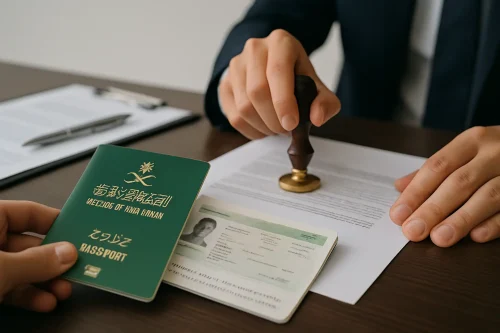

Saudi Visa Compliance Workflow for Employers
March 8, 2026
ACRO vs DBS Certificate for Saudi Visas
March 12, 2026

A visa mistake usually shows up too late – at embassy stage, at boarding, or after arrival when the activity on the ground no longer matches the entry permission. For Saudi Arabia, that distinction matters more than many applicants expect. A business visitor attending meetings is not treated the same as a foreign national taking up employment, and trying to use one route for the other creates avoidable delays, refusals, and compliance exposure for both traveller and sponsor.
If you are deciding between a business visit visa and a work visa, the right question is not which one is quicker. It is which one matches the activity you will actually carry out in the Kingdom.
Saudi business visa vs work visa: the core difference
The simplest way to separate the two is this: a Saudi business visa is for temporary business-related visits that do not amount to local employment, while a Saudi work visa is for an individual who is being hired or assigned into a role in Saudi Arabia and will enter the Kingdom under an employment arrangement.
That sounds straightforward, but the grey area is where problems begin. Many travellers say they are “just going for a project” or “only visiting a client site”. In practice, the decision turns on what they will do day to day, who controls the work, how long they will stay, whether there is a Saudi sponsor hiring them, and what supporting approvals are required.
For HR teams and mobility managers, this is not an administrative detail. It affects eligibility, document collection, legalisation, medicals, police clearance requirements, verification steps, and the expected processing path.
When a Saudi business visa is usually the correct route
A Saudi business visit visa is generally used for short-term commercial activity such as meetings, negotiations, site visits, attending discussions with a Saudi company, or exploring commercial opportunities. It is suitable where the traveller remains a visitor rather than an employee entering the Saudi labour framework.
In most cases, this route is used by executives, sales teams, consultants attending meetings, and technical staff making limited visits where the purpose stays within the scope permitted by the invitation and current rules. The key point is that the visa does not convert a visitor into a local employee.
This is where applicants need to be careful. If a person is effectively filling a role, working under a Saudi employer’s direction, or carrying out labour activity beyond a business visit scope, a business visa may be the wrong route even if the trip is short.
The attraction of the business visa is obvious. It is often faster and lighter on paperwork than a full employment route. But faster is only useful when it is lawful for the intended activity. If the scope on the ground does not match the visa class, the convenience disappears very quickly.
Typical indicators for a business visit visa
A business visa is more likely to fit where the traveller is attending meetings, discussing contracts, reviewing operations, or making a time-limited commercial visit without taking up salaried employment in Saudi Arabia. It may also suit certain short technical visits, but those cases need careful screening because the boundary between permitted technical attendance and unpermitted work can be narrow.
This is why sponsors and applicants should not rely on informal assumptions. The invitation wording, host company details, nationality, profession, and current consular practice all matter.
When a Saudi work visa is the correct route
A Saudi work visa is the proper route for someone who is relocating to take up employment in the Kingdom. This includes long-term hires, sponsored staff, and individuals who will enter Saudi Arabia to perform a defined job for a Saudi employer.
Compared with a business visa, the work visa route is document-heavy and compliance-led. The applicant may need an employment contract, qualification documents, attestation or legalisation, medical testing, and police clearance documentation, depending on role and nationality. There may also be profession-specific or employer-specific requirements, along with verification stages such as QVP or Mosadaqa where applicable.
For regulated, technical, and engineering roles, the scrutiny is usually higher. Job title alignment, degree relevance, sponsor records, and document consistency all affect the outcome. A mismatch between the applicant’s papers and the authorised profession can lead to delay or rejection.
Why employers should not shortcut to a visit visa
Some employers are tempted to send staff quickly on a business visa while employment paperwork catches up. That approach can create a larger delay later, especially if the traveller’s activity is clearly work-related. It may also complicate future applications if the travel history and declared purpose do not align.
For corporate sponsors, the safer route is usually the compliant route. Proper category selection at the start reduces rework, protects the employer, and minimises the chance of embassy-stage issues.
The document burden is very different
One of the clearest differences in the Saudi business visa vs work visa decision is the supporting file.
A business visa application is generally built around invitation and travel-purpose evidence. A work visa application is built around employment eligibility and sponsor compliance. That means the work route often involves considerably more preparation before submission.
Applicants moving on work visas may need academic documents processed correctly, police clearance obtained in the right format, medicals booked with approved centres, and commercial or personal documents legalised through the appropriate chain. Verification failures, missing stamps, inconsistent names, or old certificates can stop progress.
For this reason, timelines for work visas are rarely just “visa timelines”. The real timeline includes pre-processing – gathering, checking, certifying, verifying, and aligning each document before the embassy file is ready.
Which visa is faster?
Usually, the business visa route is faster. But that is only relevant if the business visa is the correct category.
A work visa takes longer because it involves more parties and more compliance steps. The Saudi employer, official systems, document issuers, medical providers, verification channels, and embassy process all need to line up. If any item in that chain is incomplete, the file stalls.
That said, a wrongly selected business visa is not truly faster. If the applicant is later stopped, asked to reapply, or prevented from carrying out the intended activity, the overall timeline becomes longer and more expensive than filing the correct work route from the outset.
Common confusion points
The biggest confusion is around short-term project work. Many applicants assume that if the trip is brief, it must be a business visa. Saudi processing does not work on trip length alone. A five-day trip can still involve work activity, while a longer stay can still be a legitimate business visit, depending on the purpose.
Another problem is job-title language. Applicants often describe their travel casually – “installation support”, “project delivery”, “training”, “supervision”. Some of these activities may trigger closer review because they move beyond simple meetings or commercial discussions. The exact scope matters.
There is also confusion between entry permission and practical permission. A person may hold a visa and still face issues if the documents behind the trip, the host company records, or the actual activity in Saudi Arabia do not match what was declared.
How to decide correctly
Start with the activity, not the preferred processing speed. Ask who the traveller will report to, what they will physically do in Saudi Arabia, whether they are filling a role, whether a Saudi sponsor is employing them, and whether the purpose can be supported cleanly by the invitation or employment file.
Then review the evidence needed for that route. If the case requires degree attestation, police clearance, medical screening, sponsor-side approvals, or verification checks, it is usually pointing towards a work route rather than a simple business visit.
For employers managing multiple deployments, consistency is critical. Different departments often describe the same role in different ways, and that creates risk. Internal alignment between HR, the Saudi sponsor, the employee, and the visa processor prevents contradictory paperwork.
Where there is any doubt, it is worth having the case screened before documents are submitted. SaudiVisa.London handles this type of pre-checking specifically because small classification errors can cascade into larger processing problems.
A practical rule for employers and travellers
If the purpose is meetings, relationship management, commercial discussions, or a temporary visit that stays firmly outside employment, a business visa may be appropriate. If the person is being hired, assigned into a job, or expected to perform work as part of an employment arrangement in Saudi Arabia, the work visa route is usually the correct one.
The trade-off is simple. Business visas can be lighter and faster, but only within their permitted scope. Work visas involve more preparation, but they provide the proper basis for lawful employment and reduce risk where the role clearly falls within the Saudi labour framework.
The safest applications are not the quickest-looking ones. They are the ones where the visa category, documents, and real purpose of travel all match from day one. That is what keeps a file moving when scrutiny increases, and it is what saves time when the stakes are highest.


