






Apostille for Saudi Arabia from the UK: What to do
February 21, 2026
Mosadaqa verification help that prevents delays
February 23, 2026

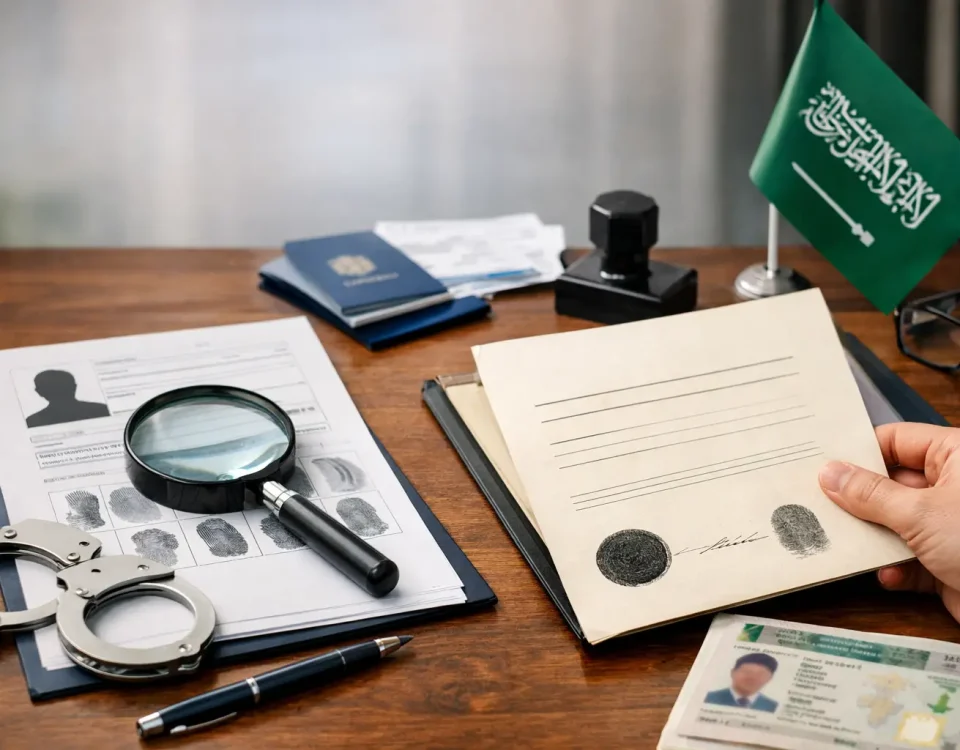
A Saudi work visa file can be perfect on paper, then stall on one avoidable point: your supporting documents are not legalised in the way the Saudi authorities expect. That is what most people mean when they say “MOFA legalisation” – and it is also where timelines slip, start dates move, and HR teams end up reissuing assignments.
This guide is written for applicants and sponsors submitting from London (and beyond), where documents often pass through multiple verification layers before they are accepted for Saudi immigration, employment onboarding, or dependent entry. The aim is simple: get your documents into the correct chain, with the correct stamps, in the correct order, so your visa and compliance workflow keeps moving.
What MOFA legalisation actually means in Saudi practice
MOFA is the Ministry of Foreign Affairs in Saudi Arabia. In practical terms, “MOFA legalisation” is the Saudi-side confirmation that a document – and the signatures/stamps on it – are recognised for official use in the Kingdom.
The nuance that causes most confusion is that MOFA does not normally act as your first step. For many UK-issued documents, the Saudi system expects you to prove authenticity at source (UK) and then have it accepted through the Saudi diplomatic channel (embassy/consulate) before it reaches a point where MOFA can validate or register it for use in Saudi processes.
So, when people search for mofa legalisation Saudi documents, they are usually trying to solve one of these operational problems:
First, a visa or onboarding portal (often tied to the employer’s compliance steps) is rejecting documents that are not legalised in a Saudi-recognised way.
Second, they are preparing personal status documents (marriage, birth) for dependants and need them recognised for residence, schooling, or healthcare.
Third, they are moving regulated professionals and the employer needs an auditable chain of authentication for degrees, professional certificates, and police clearances.
The result you are aiming for is not “a stamp for the sake of it”. It is acceptance – by the Saudi embassy stage, and then by Saudi receiving authorities who rely on MOFA-validated paperwork.
Which documents typically need MOFA legalisation
It depends on your visa category and what the Saudi sponsor’s compliance team has been instructed to collect, but the same document types appear repeatedly.
For Saudi work visas and employment onboarding, the high-frequency items are degree certificates, professional qualifications, experience letters, and police clearance documents (often an ACRO certificate for UK applicants). If the role is in engineering, healthcare, education, or other regulated sectors, the tolerance for inconsistencies is low because the downstream checks are stricter.
For family residence or visit visas, marriage certificates and birth certificates commonly require legalisation so they can be used for dependent visas and, later, in-country services. In many cases, the document is acceptable only if it carries the expected chain of verification, not just a local UK certificate extract.
For business travel, legalisation is less common but still arises for certain corporate actions such as authorisations, board resolutions, or letters that need recognition in Saudi Arabia. If your Saudi counterpart requests legalised corporate documents, treat it as a compliance requirement, not a courtesy.
The usual legalisation chain for UK-issued documents
The order matters because each stage validates the one before it. If you skip a step, you often do not find out until the embassy submission – or worse, after the document has travelled and someone in Saudi rejects it.
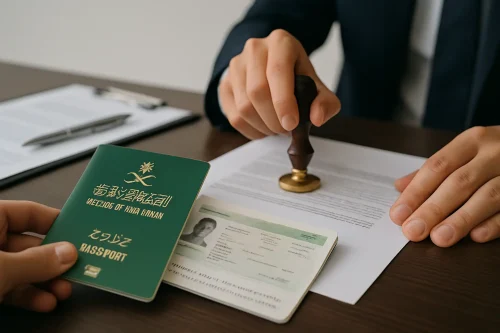
For many UK-origin documents, the sequence is typically: document preparation (and sometimes notarisation), UK authentication (commonly via apostille where applicable), Saudi embassy/consular legalisation, then Saudi-side MOFA handling where required for the end use.
Two trade-offs are worth stating clearly.
First, whether notarisation is needed depends on what the document is. Original civil registry documents and certain official certificates may not require notarisation in the same way a company letter or copy set does. If you notarise unnecessarily, you can add cost and time. If you fail to notarise when required, you can lose weeks.
Second, “apostille” is not the same as “Saudi legalisation”. People sometimes assume an apostille ends the process. For Saudi use cases, the apostille can be a mid-step that supports embassy processing rather than replacing it.
Because requirements can change by document type and by the Saudi receiving authority, your safest operational approach is to confirm the chain against the actual purpose: visa issuance, employment onboarding, or dependent residence.
Where applications go wrong (and how to prevent it)
Most rejection reasons are not complicated, but they are expensive.
The first is mismatched names. If your passport name, degree name, and experience letter name differ (middle names, order, spelling, or transliteration), the legalisation chain can still be completed – but the receiving authority may reject it for identity mismatch. Fixing it later usually means reissuing letters or producing sworn statements, which slows the whole visa file.
The second is date and content inconsistencies. Employment letters that do not specify role title, dates, or employer details in a consistent format can be considered insufficient for the compliance step they are meant to support.
The third is submitting copies when originals are expected, or presenting originals when a certified copy set is required for stamping. This varies by document and by process stage.
The fourth is using the wrong document version. For example, a basic certificate printout may not be acceptable where a full certified extract is required.
The prevention strategy is procedural: confirm the end use, standardise names across documents, and build the legalisation plan before you start collecting stamps.
How MOFA legalisation ties into work visas, QVP, and employer compliance
For skilled roles, the visa application is often only one part of the compliance picture. Employers may also need to satisfy verification requirements such as QVP (Qualification Verification Programme) and other platform-driven checks.
MOFA legalisation is not a substitute for those verifications. Instead, it often runs alongside them and can become a gating item if a Saudi authority or employer portal requires legalised documents to progress.
If you are an HR or mobility lead, the key operational point is sequencing. If you wait to start document legalisation until after an upstream verification request arrives, you can trap your candidate in a holding pattern. If you legalise everything without checking what is actually required, you increase cost and introduce avoidable handling risk.
A controlled approach usually works best: legalise the documents that are predictable for the visa type and role, then add items only when the sponsor’s compliance checklist confirms they are needed.
Timelines: what is realistic and what affects speed
Legalisation timelines are not fixed because they depend on document readiness, whether corrections are needed, appointment capacity at relevant offices, and the number of documents in the pack.
If your documents are clean and consistent, the chain can move quickly. If you need to reissue a degree letter, correct a name, or replace a police certificate that has expired for the intended use, the clock resets.
Speed is also affected by how you package documents. Submitting a mixed bundle with inconsistent formatting increases the chance of queries. Submitting standardised, properly prepared documents reduces the back-and-forth.
If you have a start date, work backwards from it and build in buffer. In real operations, the delay is rarely the stamping itself – it is the discovery of an error halfway through the chain.
When it makes sense to use an agency
Some applicants can manage legalisation independently, especially if they have one document type, plenty of time, and no sponsor-driven compliance complexity.
It becomes less efficient when you are coordinating multiple document types, multiple applicants (for example, a family), or multiple jurisdictions. It also becomes higher risk when the visa is role-critical, the employer has strict onboarding deadlines, or the case involves regulated professions where documentation is routinely scrutinised.
An agency earns its keep by reducing handling errors, confirming the correct chain for the intended Saudi use, and managing submission packaging so documents are accepted first time. If you are coordinating from London while the sponsor is pushing for speed in the Kingdom, having one operator controlling the workflow tends to reduce surprises.
If you need end-to-end support for legalisation alongside Saudi visa filing, SaudiVisa.London positions itself as a single vendor that can manage both UK-side preparation and Saudi-side compliance steps, which is often the difference between a predictable timeline and repeated rework.
Practical checkpoints before you start
Before you spend money on stamps and courier moves, run these quick checks. Confirm your passport name format and ensure every document matches it. Verify whether you need originals or certified copies for each item. Ensure letters include the details the receiving authority will actually use, not just a generic statement.
Also confirm whether any documents have validity expectations for the process you are entering. Police clearances and medical-related paperwork can be time sensitive. Even where the document remains “true”, it may be considered outdated for visa or onboarding purposes.
Finally, align with your sponsor early. A two-minute confirmation of what their portal or compliance team expects can save weeks of reprocessing.
A closing thought that helps on the day things change
Saudi documentation rules do change, and not always with much notice. The best way to protect your timeline is not to guess the latest requirement – it is to run a controlled, evidence-driven process: confirm the end use, prepare documents to a consistent standard, and keep the legalisation chain tight so a last-minute compliance update does not turn into a last-minute rejection.