







MOFA Visa Stamping Saudi Process: Fast, Clean Steps
February 18, 2026
How to Apply for a Saudi Arabia Business Visa in London, UK
February 19, 2026

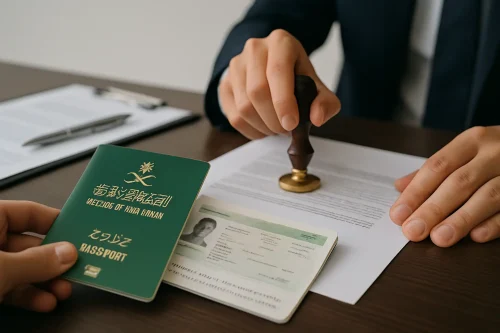
If your Saudi visa process is moving quickly, the bottleneck is rarely the form. It is the handover point where your case becomes an embassy-facing file – complete, consistent, and compliant. That is what “saudi embassy submission London” really means in practice: the moment your documentation, sponsor details, attestations, and portal outputs have to align, or you lose days (sometimes weeks) to rework.
This is why professionals, HR teams, and mobility managers treat submission as a controlled checkpoint, not a final admin chore. The submission step is where preventable errors convert directly into delays, rejections, or a file that cannot be accepted until corrected.
What “saudi embassy submission London” involves
Embassy submission is not simply “dropping off documents”. It is the structured presentation of a visa application pack that meets current Saudi entry and employment rules, plus whatever validations apply to your category.
In most real-world cases, submission includes:
- a defined visa category (work, business visit, temporary work, family residence/visit)
- sponsor-side documents and references that must match the applicant’s details
- applicant documents that may need legalisation or verification before they can be accepted
- portal-generated outputs where applicable (for example, employer-linked processes and third-party verifications)
The trade-off is straightforward: you can move fast, or you can move correctly, but if you try to move fast without controlling the document chain you usually end up moving slowly anyway. Submission works best when it is treated as the end of a staged workflow.
Why London submissions fail – and where time is lost
Most delays are not caused by “complex Saudi rules” in the abstract. They are caused by mismatches and missing compliance steps that only become visible when the file is checked as a complete pack.
Inconsistent data across documents
Names, passport numbers, job titles, and dates must match across the application, sponsor letter(s), contract documents, and any third-party verification outputs. A small variation – such as different spellings, missing middle names, or a job title that does not align with the sponsor’s authorisation – can force a resubmission.
For corporate mobility teams, this is where version control matters. If HR updates a job title after documents have been drafted, you need to re-check the entire pack, not just the one page that changed.
Missing legalisation or the wrong legalisation sequence
If your visa route requires legalised UK documents, the sequence and format matter. An apostille is not interchangeable with Saudi-side legalisation steps, and not every document needs the same treatment.
It depends on your visa type and sponsor requirements, but a common failure pattern is submitting documents that are notarised but not properly legalised, or legalised but not in the format the receiving party expects.
QVP, Mosadaqa, and verification gaps
Verification requirements have tightened, particularly for employment-linked applications and regulated professions. If your process requires QVP verification or Mosadaqa checks, the embassy-facing file must reflect those outputs correctly.
A typical delay occurs when the applicant assumes verification is “in progress” and submits anyway. Submission usually needs proof of completion or a compliant status that the receiving workflow accepts. “We have started it” is not the same as “the file is ready”.
Police clearance and medical timing problems
ACRO police certificates and visa medicals are time-sensitive and can create scheduling pressure. The practical risk is either submitting without a required document, or submitting with a document that falls outside acceptable validity windows.
This is a planning issue more than a paperwork issue. If you only book medicals after everything else is prepared, you may miss your target travel date. If you book too early, you may end up re-doing tests.
What to prepare before you submit
Embassy submission should be the final step in a controlled chain. Before you reach it, you want a pack that is internally consistent, category-correct, and supported by the right verifications.
Step 1: Confirm the visa route and who owns which parts
Start by locking the visa type and the sponsor scenario. Work visas, business visit visas, temporary work visas, and family visas each create different documentary obligations.
For employers, the key control is ownership. Decide who owns: applicant identity documents, sponsor letters, verification steps, and appointment logistics. When ownership is unclear, documents drift and you end up rebuilding the pack at the end.
Step 2: Build a “single source of truth” for identity details
Use the passport as the authoritative source for spelling, order of names, and date formats. Then force every document to match it.
This is the fastest way to prevent the most common embassy-facing mismatch. It also reduces risk when third parties generate outputs (for example, verification portals that pull data exactly as entered).
Step 3: Prepare supporting documents with legalisation in mind
If a document needs to be used in Saudi processes, treat it as an export document, not a domestic UK document. The evidence chain often matters as much as the content.
If you are unsure whether a document needs apostille, MOFA-related legalisation, or additional verification, do not guess. Guessing is how you create a “nearly correct” pack that still cannot be accepted.
Step 4: Align job title, profession, and evidence for employment-linked cases
For work visas and certain temporary work routes, job title alignment is a compliance issue. The job title used by the sponsor, the employment contract, and any verification steps should not be treated as separate creative choices.
If your role is technical or regulated, expect higher scrutiny. This is where early document review saves time: you can adjust evidence and wording before legalisation and verification locks the file.
Step 5: Plan ACRO and medicals around your submission window
Work backwards from your intended submission date. If your police certificate and medical report are required, you need them ready at submission, not planned for the week after.
The trade-off is cost versus certainty. Some applicants try to delay paid steps until “everything is approved”. In practice, if those documents are mandatory, delaying them often delays your submission more than it reduces risk.
Submission day: what “good” looks like
A strong submission is boring. It is predictable, traceable, and complete.
The file should read as one coherent story: the applicant is who they say they are, the sponsor is requesting the correct visa category, and every supporting document is properly prepared for Saudi use.
In operational terms, this means your pack is ordered, your copies are clear, and your key references and outputs are present. If something is pending, you either hold submission until it is complete or you confirm – in advance – that the process genuinely allows submission with that element outstanding.
How long does Saudi embassy submission in London take?
The honest answer is: it depends on the visa type, the time of year, the completeness of the pack, and whether additional verification steps apply.
If your file is clean, timelines are usually driven by the visa category and the current queue rather than by “mystery delays”. If your file is not clean, timelines become unpredictable because every correction introduces new waiting time.
For employers managing multiple hires, this is why standardisation pays off. A repeatable document checklist, consistent naming conventions, and early verification reduce variability across cases.
When you should use a managed submission service
There are two clear scenarios where managed submission is more than convenience.
The first is when the applicant and sponsor are in different places (for example, UK-based candidate with Saudi-based sponsor operations). Coordination failures are common here because each side assumes the other has completed a step.
The second is when your case includes multiple compliance dependencies – legalisation, Mosadaqa, QVP verification, ACRO, and medicals – and you have a fixed start date. At that point, the cost of one mistake usually exceeds the cost of professional handling.
If you want a single operator to run the full chain from requirements gathering through verification, legalisation, and submission, SaudiVisa.London can manage end-to-end Saudi visa processing with secure document handling and compliance-led workflows: https://saudivisa.London.
Practical risk controls for HR and mobility teams
If you are sponsoring multiple travellers or relocating staff into Saudi Arabia, the submission step is where process discipline shows.
Treat every case as auditable. Keep a clear record of what was submitted, which version, and based on which identity source. If a document is reissued, mark the earlier version as superseded and ensure it is not reused.
Also be realistic about change requests. If the job title or start date changes late, you may need to re-run downstream steps. The fastest teams are not the ones who push papers hardest at the end – they are the ones who prevent late-stage changes from breaking the compliance chain.
Closing thought: if you want speed, build it into the process before submission day. Embassy submission rewards preparation, not optimism.