




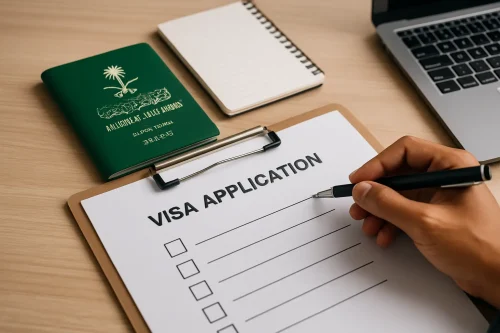


Saudi Visa Document Legalisation, Step by Step
March 6, 2026
Saudi Business Visa vs Work Visa
March 10, 2026

A Saudi hire can go off track long before the passport reaches the embassy. In most cases, the delay starts earlier – at the point where HR assumes the job title, qualification set, attestation route and pre-departure checks will line up without friction. They often do not.
For employers, a reliable Saudi visa compliance workflow is less about filing one application and more about controlling a chain of dependencies. Contract wording affects document requirements. Nationality affects verification routes. Profession affects medical, police clearance and qualification scrutiny. If one step is handled in the wrong order, the result is usually rework, delay or refusal.
Why employers need a Saudi visa compliance workflow
A proper Saudi visa compliance workflow for employers reduces risk at three levels. First, it protects start dates by identifying document gaps before the visa stage. Second, it reduces refusal exposure by matching the worker, sponsor, profession and supporting paperwork correctly. Third, it lowers administrative drag for HR and mobility teams who otherwise end up chasing multiple providers for legalisation, verification, medicals and submission.
This matters even more for regulated and technical roles. Engineers, project staff, consultants and specialist contractors are often subject to closer review on qualifications, profession matching and supporting employer records. A fast application is useful, but only if it is also compliant. Speed without document control usually creates a slower outcome.
The core stages in the employer workflow
The most effective process starts before any candidate is told to book a medical or send in a passport. Employers should begin with role and sponsor alignment. That means checking the Saudi-side purpose of entry, the correct visa category, the proposed profession and whether the sponsoring entity’s paperwork supports that route. A work visa, business visit visa and temporary work visa may all suit a commercial need, but they do not serve the same compliance purpose.
Once the route is confirmed, the next stage is document mapping. This is where many employers lose time. A degree certificate might need legalisation. A police clearance may be required depending on the visa type and profile. Certain applications may involve QVP verification, Mosadaqa verification or MOFA-related procedures. These are not optional extras if the case requires them. They are gatekeeping steps.
After document mapping comes candidate pack preparation. Employers should collect the passport copy, photographs where required, qualifications, employment evidence and any supporting letters in the correct format from the outset. If a document is likely to need correction, translation, attestation or reissue, that should be handled before submission planning begins. Sending partial files into processing rarely saves time.
The fourth stage is compliance validation. This is the internal checkpoint where the employer, or its processing partner, confirms that names match across records, dates are consistent, profession wording is suitable and supporting documents align with embassy and Saudi-side expectations. Minor discrepancies here can trigger major delays later.
Only then should the case move into formal processing, including verification, legalisation, medical coordination, official portal steps where required and embassy submission.
Where the workflow usually breaks down
Most failed or delayed cases do not fail because the employer forgot to apply. They fail because the preparatory logic was weak.
A common problem is assuming that every employee follows the same path. That is rarely true. Nationality, profession, country of qualification and application location can all change the route. An engineer applying from London may face a different supporting document burden from a consultant applying from another jurisdiction, even where the end goal looks similar.
Another issue is treating ancillary services as separate admin tasks instead of compliance steps. Apostille and MOFA legalisation, ACRO police clearance processing, visa medical coordination, QVP support and Mosadaqa verification directly affect eligibility and timing. If they are left to the applicant without central oversight, HR loses control of the critical path.
There is also the question of sequencing. For example, an employer may request embassy submission before the degree paperwork is fully compliant, or book travel before the medical and verification stages are complete. That creates avoidable pressure and often leads to premium corrections that cost more than handling the file properly at the start.
Building a workable compliance process in-house
Employers do not necessarily need a large mobility team to improve outcomes, but they do need a disciplined process. The first requirement is a single owner for each case. That may be HR, global mobility or an external visa partner, but someone must control the timeline, checklist and approvals. Shared ownership tends to create gaps.
The second requirement is a role-based intake form. Before any visa work starts, the employer should capture the visa type, work location, intended profession, candidate nationality, current country of application, qualification profile and target start date. This prevents the file from being built on assumptions.
The third requirement is a document readiness review. This should answer straightforward questions: do the candidate’s qualifications support the profession being sponsored, do those documents require legalisation, is police clearance needed, does the case fall within a QVP or Mosadaqa process, and what lead times apply? Without this review, the employer is planning blind.
A strong process also includes a pre-submission audit. This is where the case is checked against current requirements, not last quarter’s checklist. Saudi visa rules and supporting document expectations can shift, particularly around verification and document acceptance. A stale checklist is one of the most expensive mistakes a repeat employer can make.
A practical Saudi visa compliance workflow for employers
In practical terms, the workflow should move in a fixed order. Start with visa route confirmation and sponsor-side readiness. Then assess the applicant’s document set against the role. After that, initiate any legalisation, police clearance, verification and medical steps that sit on the critical path. Once those are under control, prepare the final application file for official processing and embassy submission.
That sounds simple, but the trade-off is timing. Starting every compliance step too early can create expiry issues for medicals or police certificates. Starting too late can miss project mobilisation dates. Good case management is about sequencing the long-lead tasks first while keeping date-sensitive items within valid windows.
This is where specialist handling helps. A provider such as SaudiVisa.London can coordinate UK-side preparation with Saudi-side compliance requirements, which is particularly useful where employers want one accountable point of control rather than several disconnected suppliers. For HR teams, that usually means fewer hand-offs, clearer status updates and less rework.
What employers should watch in 2025
The key issue is not simply whether a visa can be issued. It is whether the supporting file will stand up to current scrutiny without repeated amendments. Employers should expect continued attention on verification pathways, profession-document alignment and correctly prepared supporting records.
They should also be realistic about turnaround promises. A case can move quickly when documents are clean, the visa route is right and verification is started early. But where qualifications are incomplete, names vary across records or attestation is missing, there is no shortcut that removes those compliance obligations. The honest answer is that timing depends on file quality.
For employers hiring at scale, the better approach is to standardise the first half of the process. Build one intake method, one document policy and one escalation route for exceptions. That creates a repeatable workflow even when each individual case has its own compliance details.
A Saudi visa process works best when it is treated as an operational system, not a last-minute formality. If the workflow is controlled early, the visa stage becomes far more predictable – and that is what employers actually need when projects, payroll and mobilisation dates are already in motion.