






What a Saudi visa agency actually does
February 14, 2026
Saudi Family Residence Visa Documents Checklist
February 16, 2026
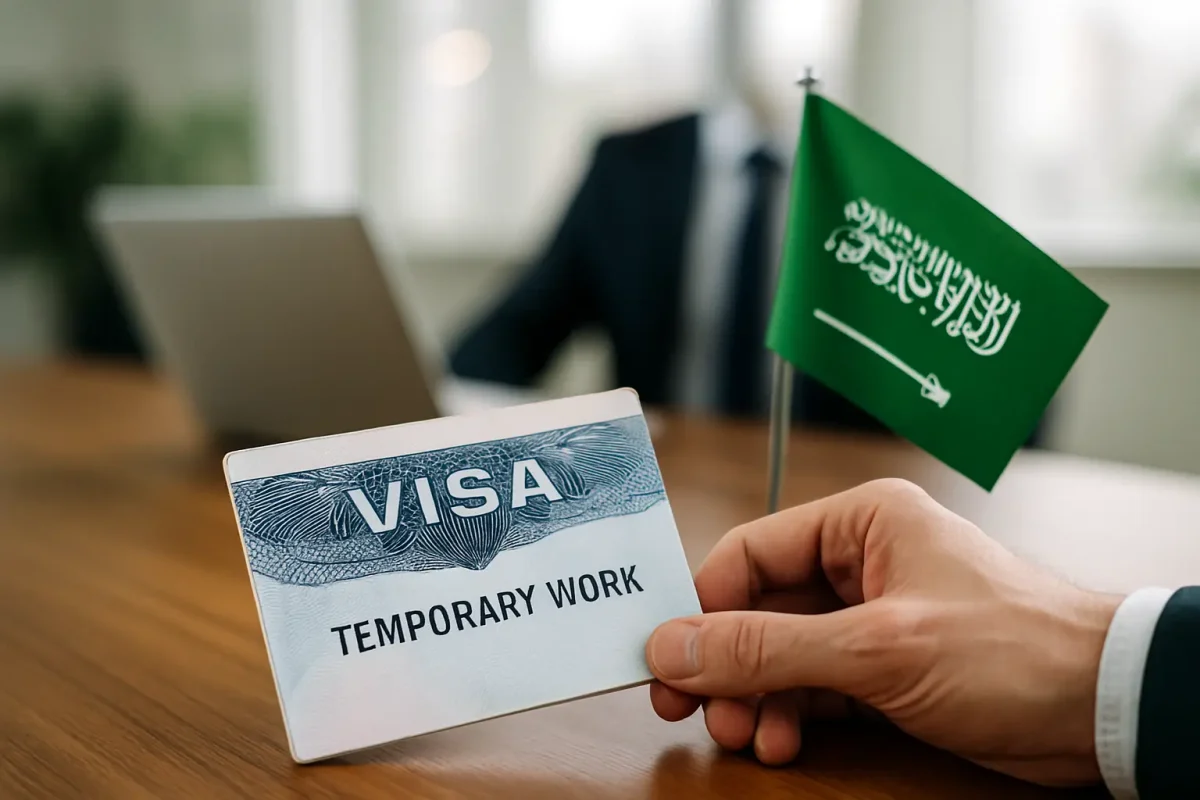
A temporary work visa for Saudi Arabia is rarely refused for “big” reasons. It is usually delayed for small ones – a mismatched job title, an unlegalised certificate, an expired medical panel, or a QVP record that does not line up with the passport. If you are an HR team moving a contractor quickly, or a professional trying to start on a fixed-term project, speed comes from treating this as a compliance workflow, not a form.
What a Saudi temporary work visa is (and what it is not)
A Saudi temporary work visa is typically used where a Saudi-based sponsor needs you in-country to perform work for a defined period, often tied to a project or short-term assignment. It sits between a business visit visa and a full employment/residence route.
The trade-off is simple. A business visit visa can be faster for meetings and limited commercial activities, but it is not designed for hands-on work in many regulated settings. A full work visa leads towards residence and longer-term employment compliance, but it can be heavier on documentation and timelines. Temporary work is attractive when you need legitimate work authorisation without committing to a full residence process – but you still have to prove identity, qualifications (where relevant), and sponsor alignment.
Who drives the application: sponsor-led, applicant-supported
Temporary work visas are sponsor-driven. Your Saudi sponsor typically initiates and controls the Saudi-side steps, including authorisation through relevant government systems. Your role (and your UK HR or mobility team’s role) is to deliver a clean document pack that matches the sponsor’s request exactly.
If the sponsor’s authorisation states “Electrical Engineer” and your supporting documentation suggests “Technician”, you have created a reconciliation problem that can slow everything down. The same applies to name formats (middle names, double-barrel surnames) and passport details.
Temporary work visa Saudi Arabia requirements: the core document set
The temporary work visa Saudi Arabia requirements depend on nationality, role, and sponsor. In practice, most applicants should expect a consistent baseline of documents, then add role-specific and verification-specific items.
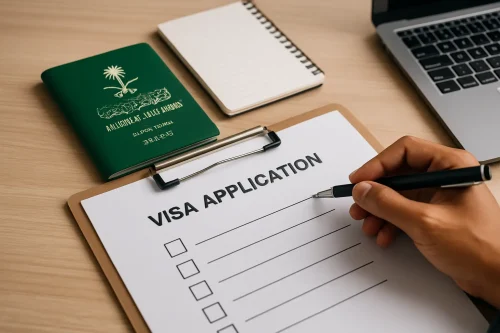
At minimum, plan for a valid passport (with sufficient validity and clean data page), compliant photographs, and a completed application aligned to the sponsor’s visa authorisation. Your employment or assignment evidence must also match the sponsor’s position and duration.
For many roles, especially technical or regulated professions, you should expect to provide evidence of qualifications. That is where processing often becomes time-critical, because qualification documents frequently require formal attestation before they are considered acceptable for Saudi use.
Passport and identity consistency
Saudi processing is unforgiving on identity matching. The passport bio page is the anchor record, and everything else should mirror it. If your certificates, police clearance, or medical forms use a different name order or omit middle names, correct this before submission where possible.
If your passport is due to expire soon, renew first. A last-minute renewal after sponsor steps have started can force rework, because authorisations and verifications can be tied to passport number.
Sponsor documentation and authorisation
The Saudi sponsor typically provides the visa authorisation details and supporting Saudi-side paperwork. Your job is to confirm the details you are working to: the visa category, job title, duration, and any specified document requirements. Do not assume last month’s process is identical to this month’s – Saudi compliance requirements can change quickly, and sponsors can have internal policy differences.
Qualification documents and attestation
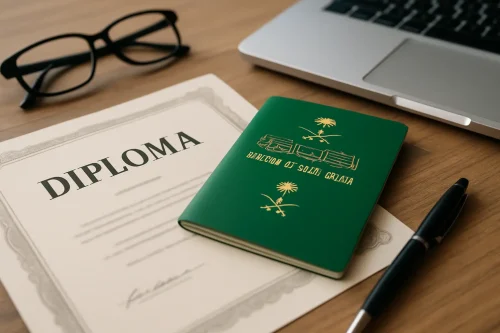
If your role requires degree certificates, professional licences, or training evidence, assume you will need them in a form acceptable for Saudi authorities. For UK-issued documents, that commonly means formal legalisation steps (often described as apostille and related Saudi authentication). This is one of the biggest schedule risks, because attestation is not instant and errors are costly.
If you are unsure whether your role triggers qualification checks, treat it as likely until the sponsor confirms otherwise. It is faster to prepare the document pack and not need it than to discover late that it is mandatory.
Police clearance (where requested)
Some cases require a police clearance certificate. UK applicants are often asked for ACRO, particularly where the sponsor’s compliance framework requires it. Police certificates can also create timing pressure because they have validity windows and need to match passport details precisely.
Do not order a police clearance with an old passport if you plan to renew. And do not ignore the address history requirements – mistakes here lead to re-issues and lost time.
Medical requirements and approved centres
Medical testing is common for work-related routes and can also apply to temporary work depending on sponsor and role. The key risk is using a non-approved clinic or missing required tests. Your sponsor or agent should confirm the correct medical route for your visa category and nationality.
If you have a tight mobilisation date, book medicals early. Even where appointments are available quickly, results and document handling can introduce delays.
Verification layers: QVP and Mosadaqa (why they slow down files)
The fastest applications are the ones that anticipate verification before it becomes a blocker.
QVP (Qualification Verification Program)
QVP is often used to verify educational credentials for certain job categories and nationalities. If your case triggers QVP, you may need to submit credentials for verification through the relevant portal and ensure the verified output aligns with your visa job title.
This is where “it depends” matters. Some applicants will not be in scope. Some will be in scope but can proceed quickly because their awarding institution and documents are straightforward. Others will hit delays because of missing transcripts, name mismatches, or institutions that do not respond quickly to verification queries.
Mosadaqa verification
Mosadaqa verification can apply to educational documents and is another common compliance step. It can be sponsor-led, agent-assisted, or applicant-managed depending on the case. Where Mosadaqa is required, plan for it early, because leaving it until the end can stop embassy submission.
The practical reality is that verification is less about whether you genuinely hold the qualification and more about whether the documents can be verified in the required format, in time, with consistent identity data.
Embassy submission from the UK: what usually goes wrong
For applicants processing from London, the UK-side submission is where “paperwork quality” becomes visible. Delays typically come from avoidable issues: incorrect photo format, incomplete forms, missing signatures, documents not properly legalised, or mismatched data fields between sponsor authorisation and applicant documents.
Another common problem is sequencing. If you submit before verification or legalisation steps are complete, you may lose time to resubmission cycles. If you wait too long and your medical or police certificate validity window closes, you may need to repeat them.
This is why experienced employers treat temporary work visas as a checklist-driven workflow with ownership, dates, and version control.
Realistic timelines: plan in weeks, not days
Timelines depend on sponsor readiness and whether your case triggers verification, medicals, and legalisation.
If your documents are ready, identity is consistent, and no additional verification is required, some cases move quickly once sponsor authorisation is issued. If you need QVP or Mosadaqa, or you are starting from scratch with legalisation, you should plan on a longer runway.
The important point is that the “visa” itself is not always the longest step. The supporting document chain can easily become the critical path.
A compliance-first process that reduces refusals and rework
If you are managing multiple hires or a single high-priority mobilisation, the safest approach is to run the file like an audit pack. Keep one master set of passport details, use consistent spelling across all documents, and do not allow job title drift between HR paperwork and sponsor authorisation.
Where you need document legalisation, police clearance, verification, and medical coordination, using a single operator can reduce handover errors. If you want end-to-end handling from requirements gathering through embassy submission, including legalisation, QVP/Mosadaqa support, ACRO processing, and medical coordination, SaudiVisa.London operates as a specialised processing agency with UK-side preparation and Saudi-side compliance coverage.
When a temporary work visa is the wrong tool
Temporary work is not always the best fit. If you are moving someone into a long-term role with payroll, dependants, or a clear path to residence, you may be better served by a full work visa route from the outset. Conversely, if the trip is limited to meetings, workshops, or site visits without hands-on work, a business visit visa may be more proportionate.
If you are unsure, do not guess. Ask the sponsor what activities will be performed in-country and what visa category their compliance team has approved for those activities. Misclassification is not just an administrative issue – it can create entry problems and future immigration friction.
A helpful way to think about it is this: the right visa is the one that still looks correct when the project changes slightly, the start date moves, or the site requires stricter access controls than expected.